 MAP
Maniago - Tour Itinerary

Hill
GENERAL INFORMATION
LAST INSPECTION DATE
13/10/2022
PLANNED ITINERARY
Maniago - Tour Itinerary
LENGTH
1200 meters
DEPARTURE
Via Maestri del Lavoro d'Italia car park - Museum of Manufacturing and Cutlery Art
The tour can take place at any time of the year.
The starting point is the car park in Via Maestri del Lavoro d'Italia, next to the Museum of Smithy Art and Cutlery (Photographs 1-2). There is a large car park along the entire street, which includes a parking space reserved for people with disability.
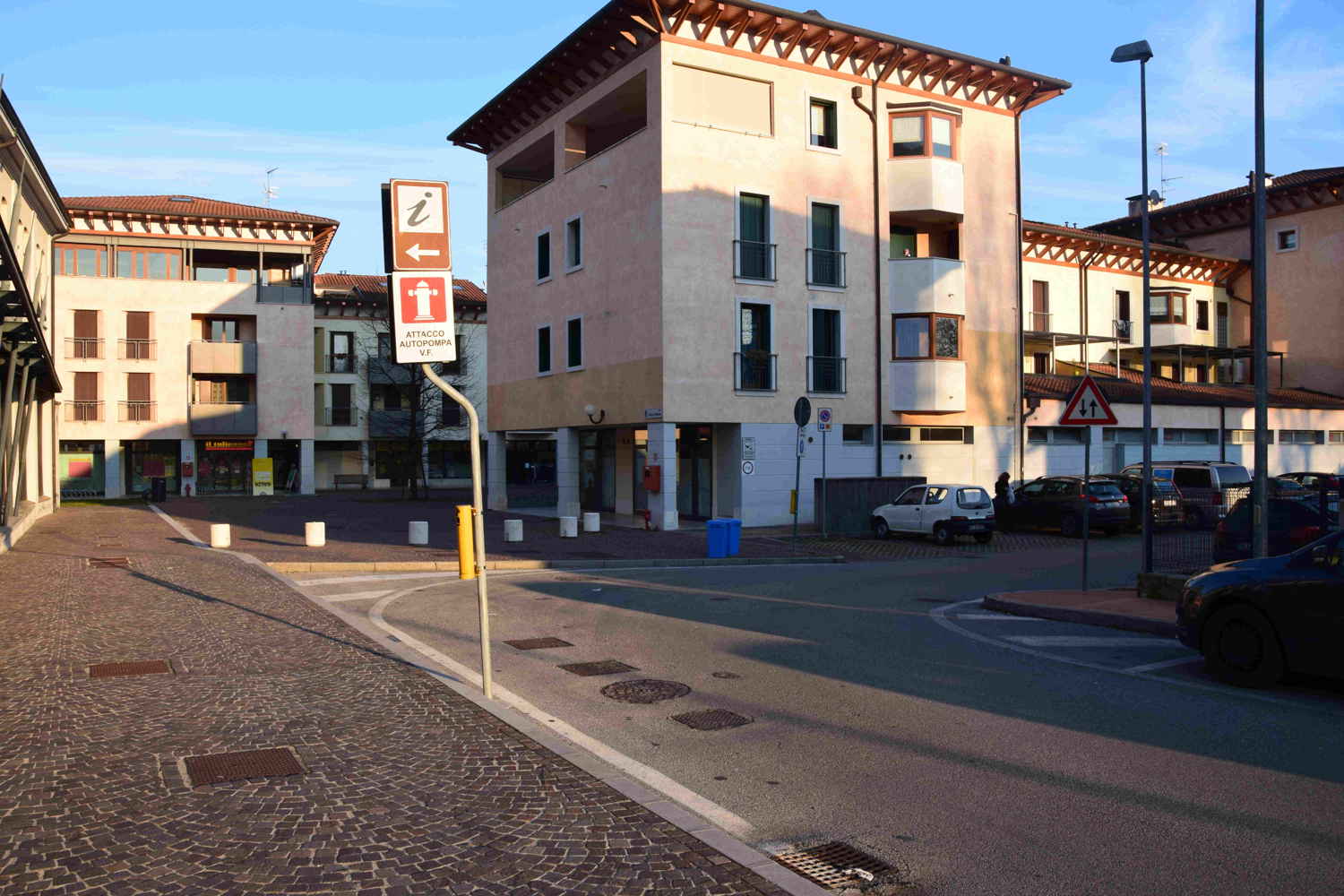
PHOTO 1 - CAR PARK IN VIA MAESTRI DEL LAVORO D'ITALIA
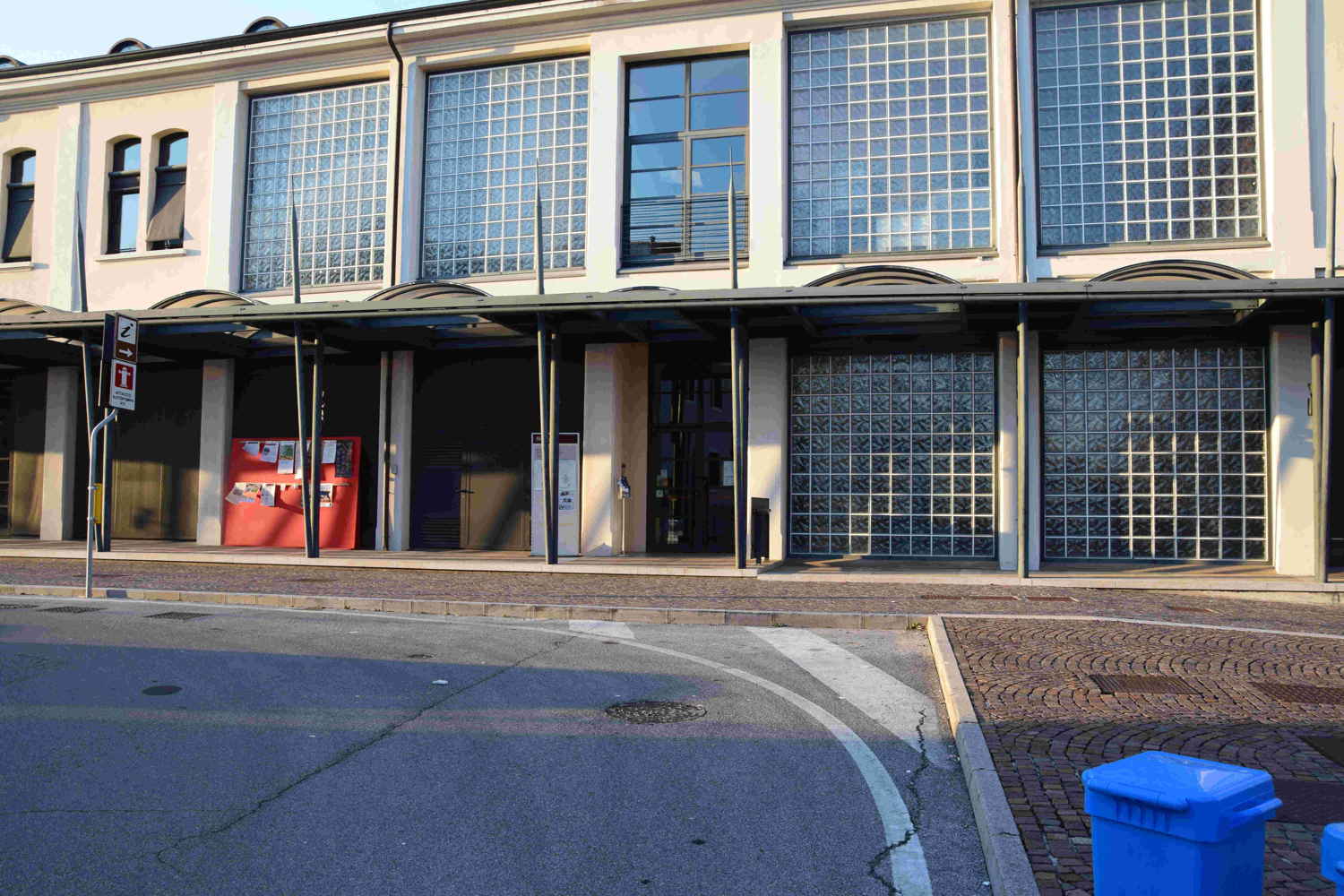
PHOTO 2 - EXTERIOR VIEW OF THE MUSEUM
The car park leads to the Museum of Smithy Art and Cutlery. It is important to note that the area in front of the museum is a pedestrian area (Photograph 3), paved with porphyry cubes, with a regular and uniform surface. The museum entrance is connected to the pavement level by a short ramp (Photographs 4-5). Next to the entrance to the museum is a large information board with a red background, black lettering, and good legibility with a series of events and information. The museum provides tactile experience trails for people with disability. The Infopoint is also located inside the museum (Photograph 6). Continuing along the itinerary, it is possible to continue along the right-hand side (Photograph 7), next to the Museum of Smithy Art and Cutlery, a level route, pavement paved with porphyry cubes, wide, uniform surface; or continue along the left-hand side: the pavement is smooth concrete, pink in colour, sufficient width for a wheelchair user, next to a series of parking spaces arranged in a line, until reaching the pedestrian crossing on Via Fabio di Maniago.
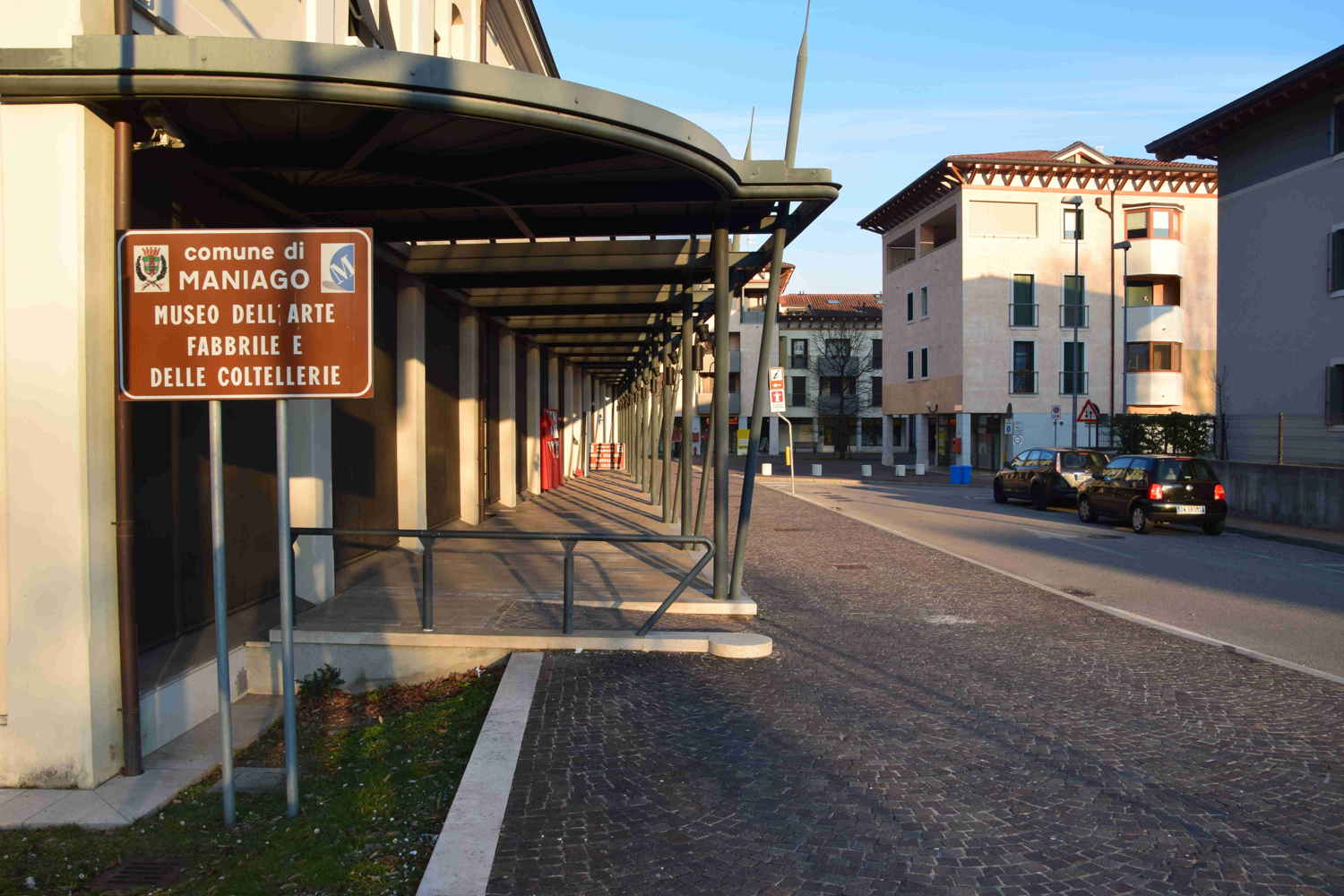
PHOTO 3 - PEDESTRIAN AREA IN FRONT OF THE MUSEUM

PHOTO 4 - SIDE ACCESS RAMP

PHOTO 5 - MUSEUM ENTRANCE
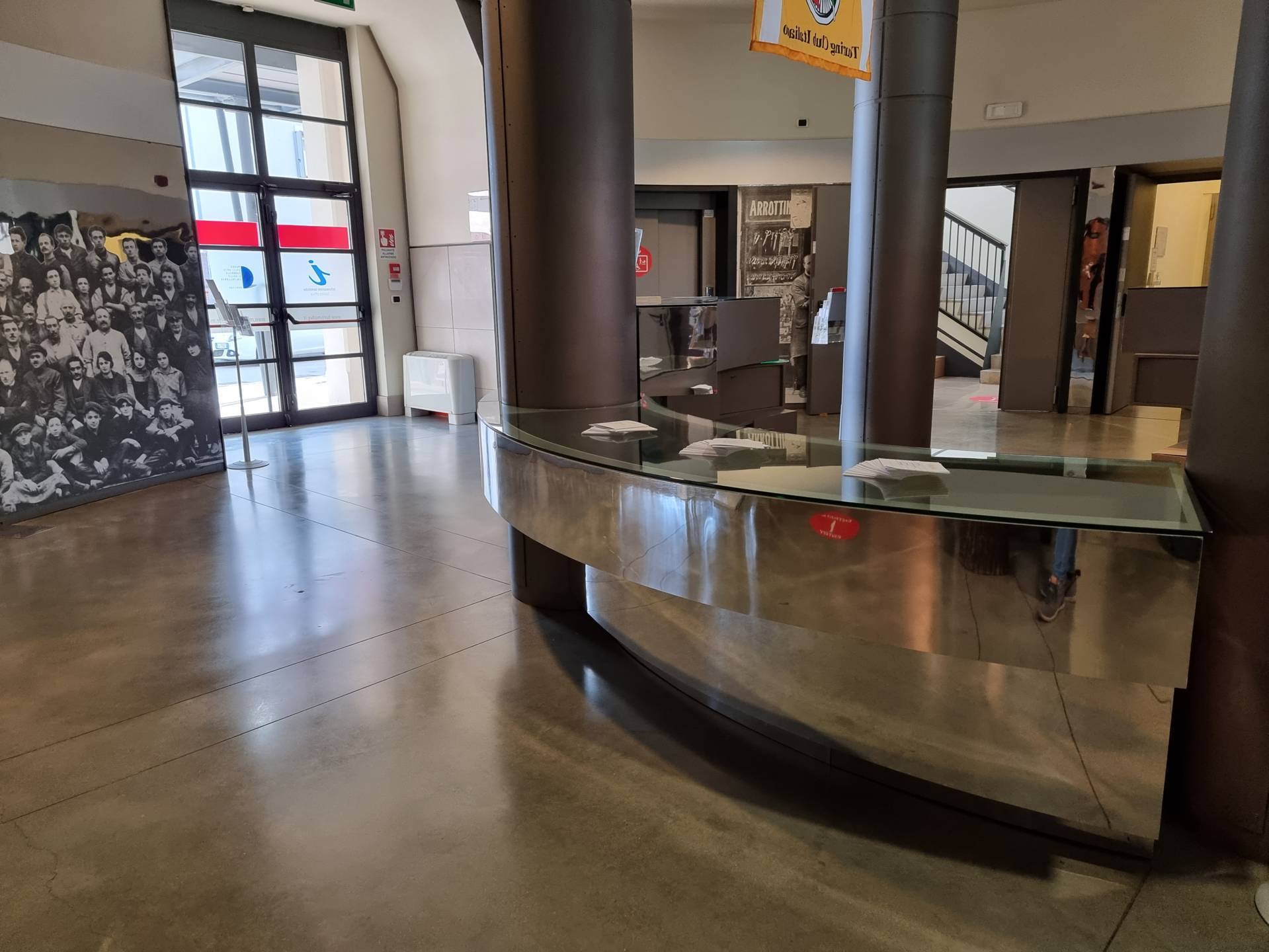
PHOTO 6 - VIEW OF THE INFOPOINT INSIDE THE MUSEUM

PHOTO 7 - PEDESTRIAN PATH ON THE RIGHT-HAND SIDE
The itinerary continues by turning right along Via Vittorio Emanuele, where there is a first pedestrian crossing (Photograph 8), which is easy to cross considering the presence of connecting ramps on both sides of the road (faded white stripes on asphalt surface, regular and homogeneous paving). The pavement along the right-hand side (Photograph 9) of Via Vittorio Emanuele (adjacent to the museum) is wide ( more than 2.50 metres), has a regular and even surface, consisting of porphyry cubes and is level. To protect the latter from the road there is a line of trees. On the left side, however, there is a brown asphalt pavement, approximately 2 metres wide, with trees narrowing the passage down to roughly 1 metre (Photograph 10).
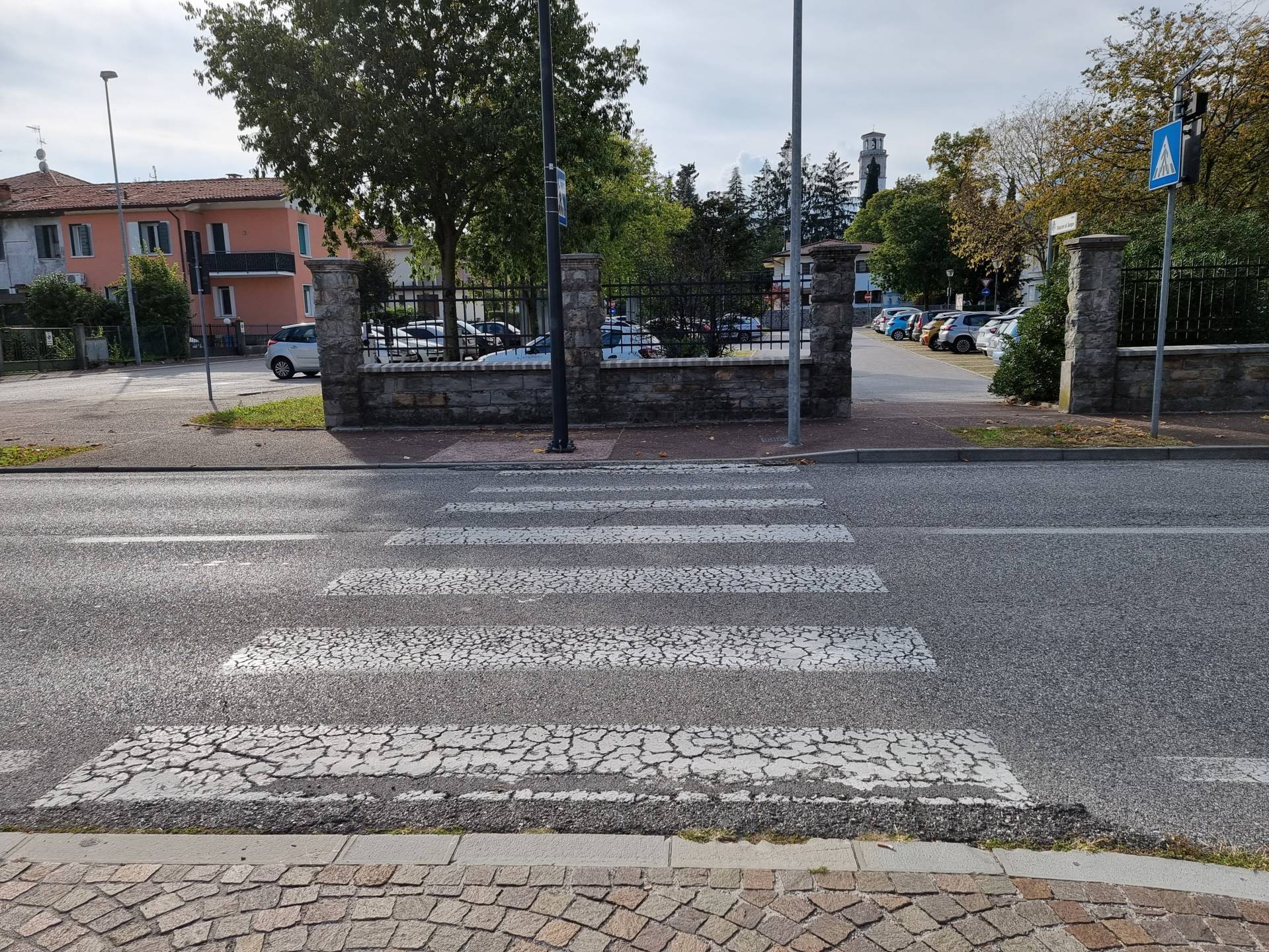
PHOTO 8 - PEDESTRIAN CROSSING ON VIA VITTORIO EMANUELE
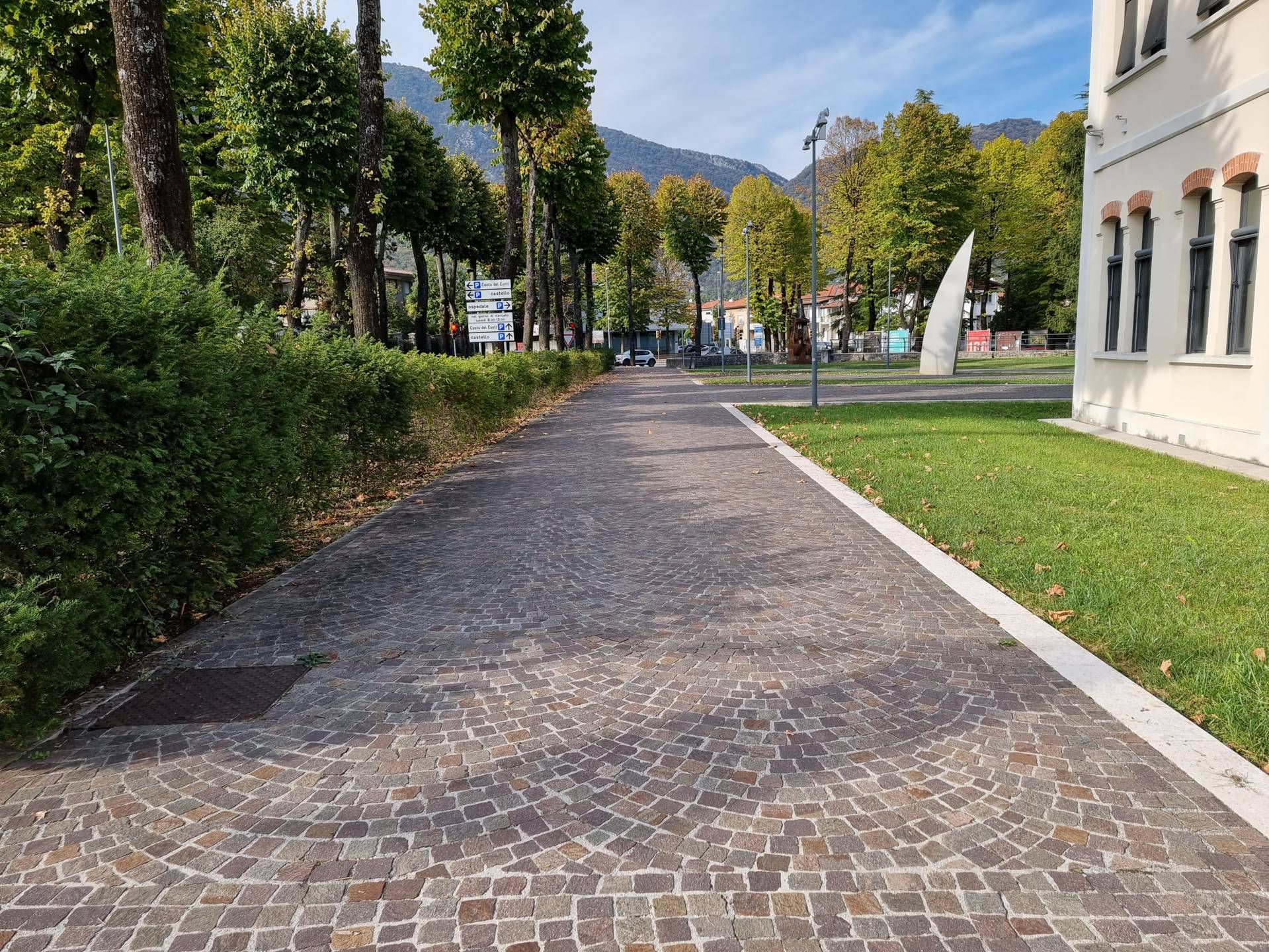
PHOTO 9 - PAVEMENT ALONG THE RIGHT-HAND SIDE
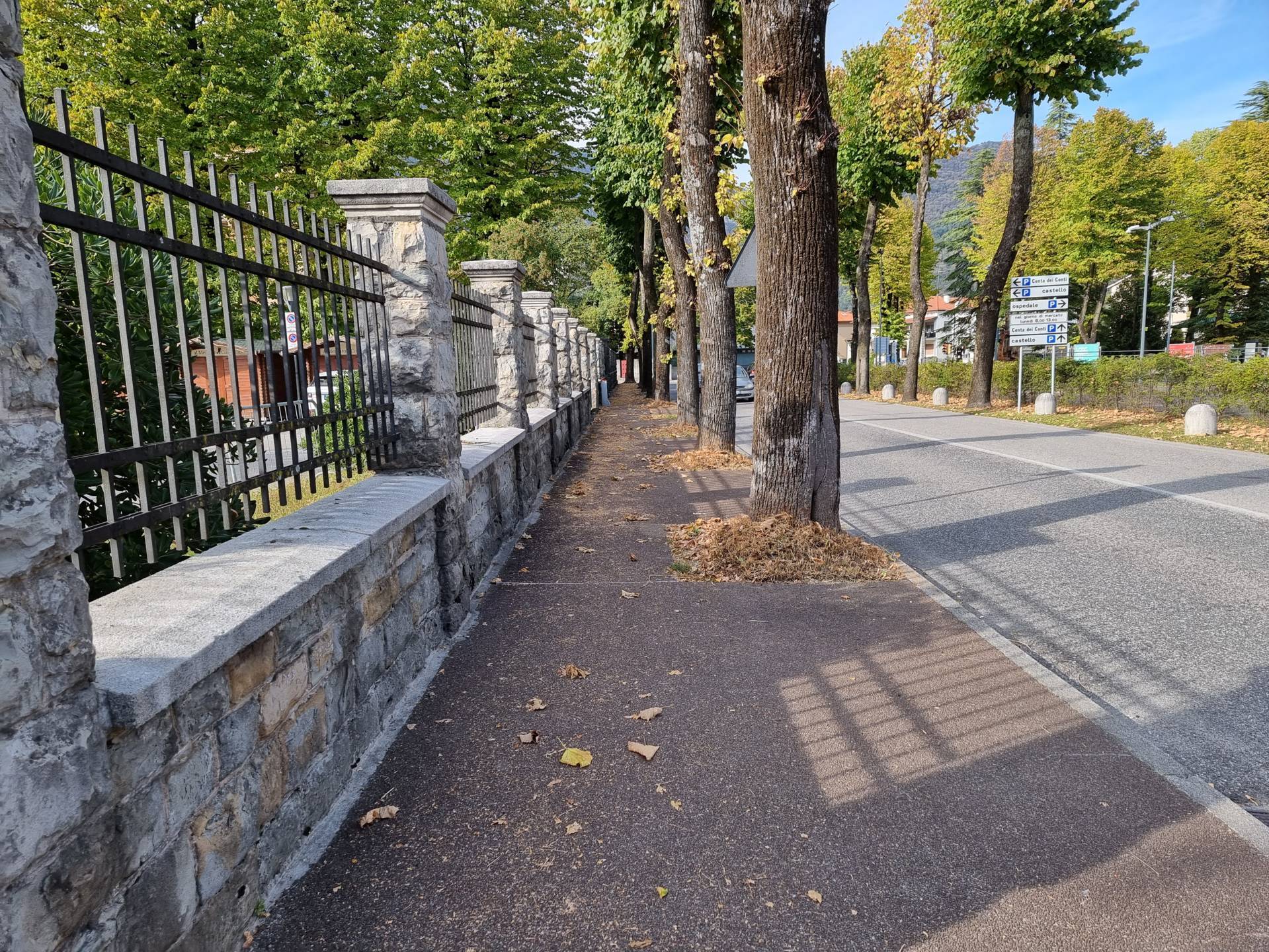
PHOTO 10 - PAVEMENT ALONG THE LEFT SIDE
Continuing in a northerly direction, towards the junction with Via Fabio di Maniago, another pedestrian crossing is located, paved with white stripes and also connected to the road surface by two connecting ramps. Cross the street, continue along the pavement and turn left towards Via Fabio di Maniago; the pavement, after the tree line, becomes wider. The surface is even, uniform, and wide (more than 2 metres in width) and made of piasentina stone slabs (Photograph 11). The first pedestrian crossing is located immediately after the bend at the junction with Via Vittorio Emanuele (Photograph 12): the surface of Via Fabio di Maniago is made of porphyry cubes, and the crossing is marked with striped road markings. The pedestrian crossing is on level, fairly even ground, connected by two ramps to the road surface. It should be noted that the crossroads with Via Fabio di Maniago and Via San Rocco have pedestrian crossings equipped with a traffic light and buzzer and ground-level LOGES modules.

PHOTO 11 - STONE SLAB PAVEMENT
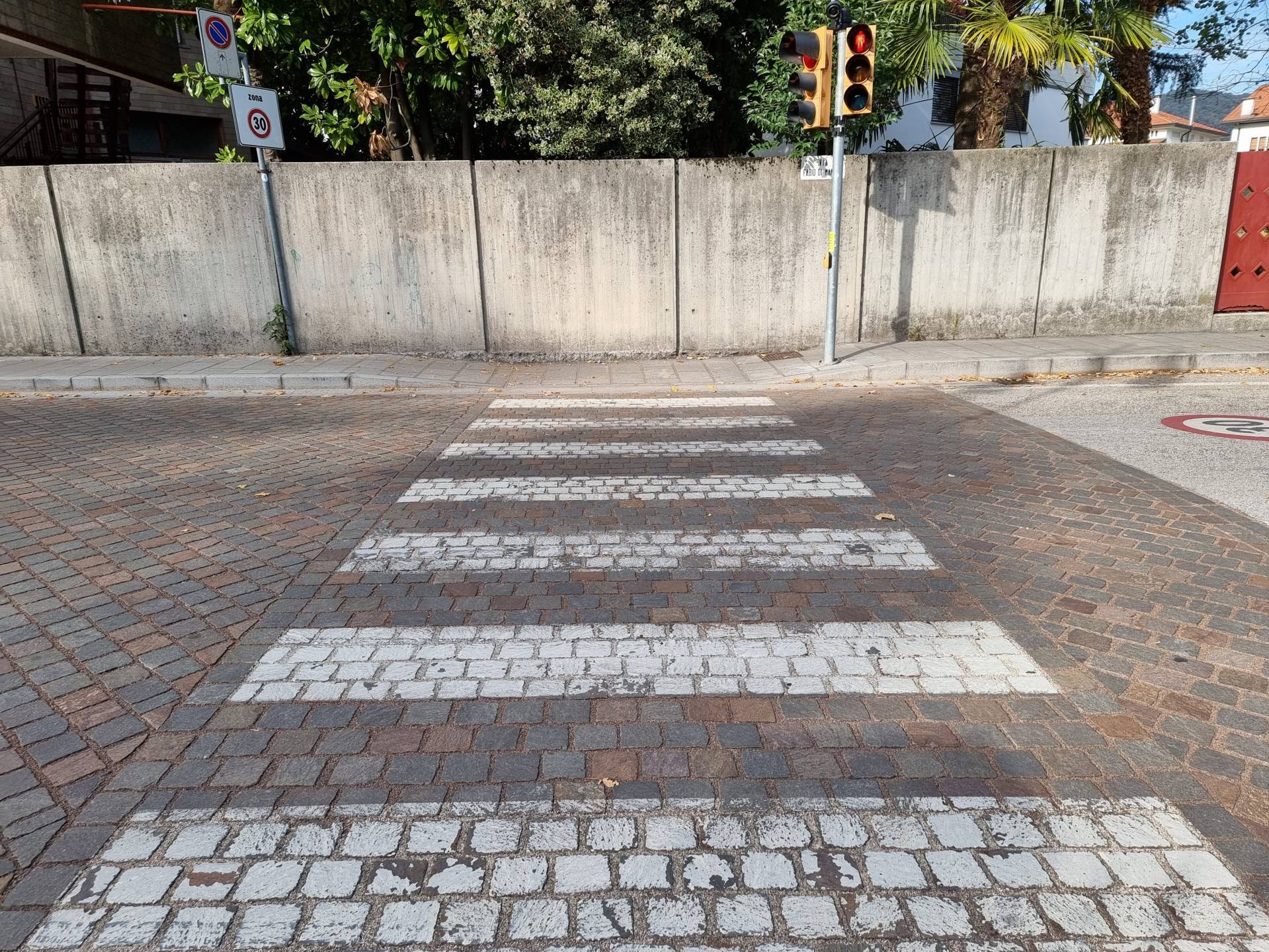
PHOTO 12 - PEDESTRIAN CROSSING
The pavement on the left side of Via Fabio di Maniago has the same characteristics as the pavement on the right side except for the width, which measures 1.50 metres (Photograph 13); at the height of the ice cream parlour, the width becomes wider. A little further on, the width of the pavement becomes even wider and a section of the itinerary can be covered under the porticoes (Photograph 14). The width of the passageway under the porticoes measures 2.10 metres and the ramp for accessing it, made of stone slabs, regular and uniform surface, measures 2.00 metres in length, 1.20 metres in width and it has a 7% slope. The floor under the porticoes, the access to the main business activities, is made of dark grey polished marble slabs. There are anti-slip strips at the ramps (under the porticoes). Continue straight ahead, passing the junction with Via Regina Elena on the left (Photograph 15): a pedestrian crossing along Via Regina Elena on a natural-coloured porphyry cube surface; the presence of connecting ramps. At street number 21 there is a parking space for people with disability.

PHOTO 13 - PAVEMENT ON LEFT SIDE

PHOTO 14 - PAVEMENT UNDER THE ARCADES
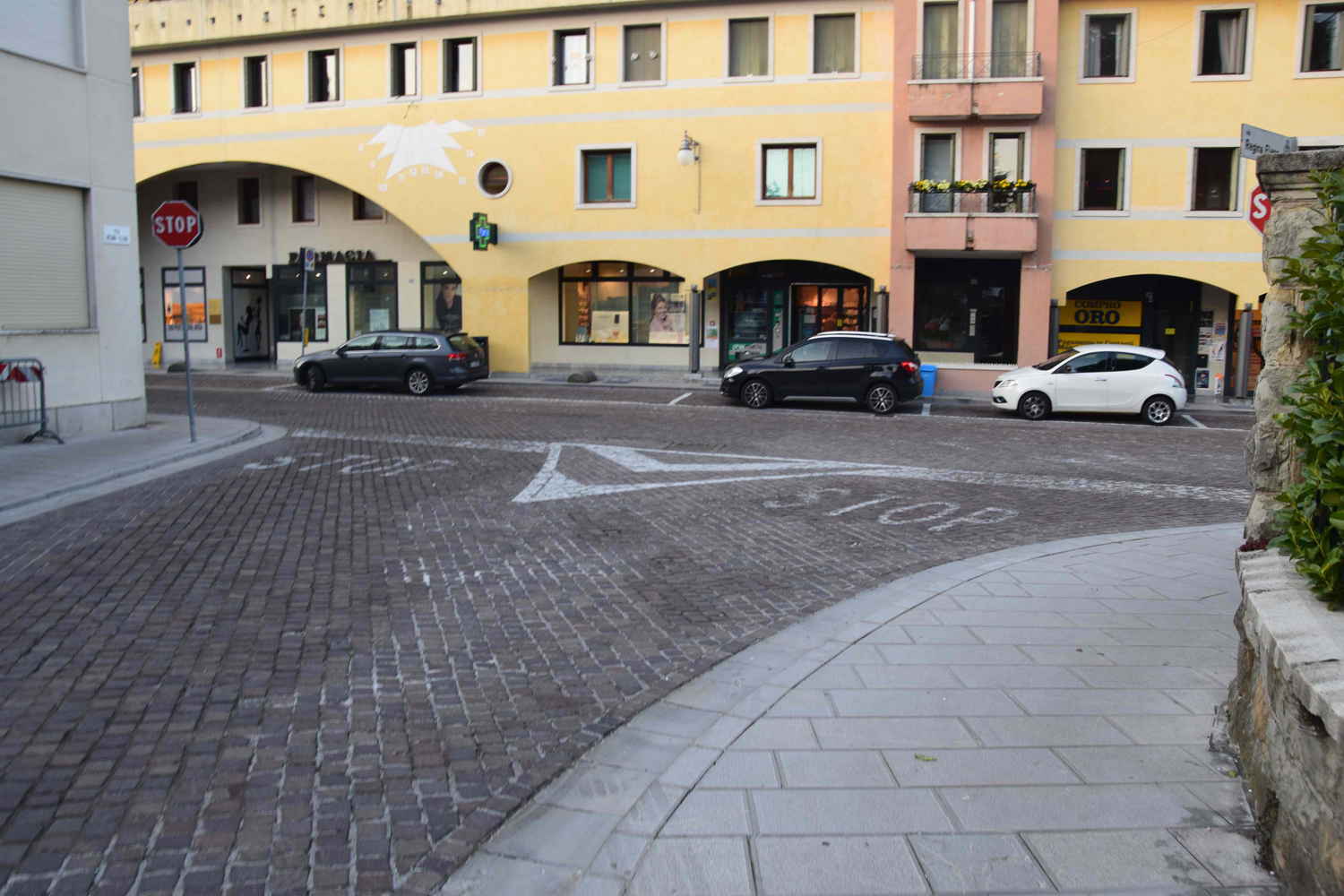
PHOTO 15 - JUNCTION WITH VIA REGINA ELENA
Another pedestrian crossing with the same characteristics as described previously is located along Via Fabio di Maniago (Photograph 16). Lastly, another pedestrian crossing is located towards the main square, connected to the pavement level with two ramps on a piasentina stone pavement; the crossing is marked by white stripes on a porphyry cube road (Photograph 17). Moving forward, visitors arrive in Piazza Italia, a large pedestrian square paved with slabs of piasentina stone and non-cracked pebbles, a regular and uniform surface, where there are two parking spaces for people with disability. The pavement on the right side is broad in width, with a uniform surface in piasentina stone, and level. On the left side, the entire area of the square, paved for the most part with slabs of piasentina stone, becomes a pedestrian area (Photograph 18).
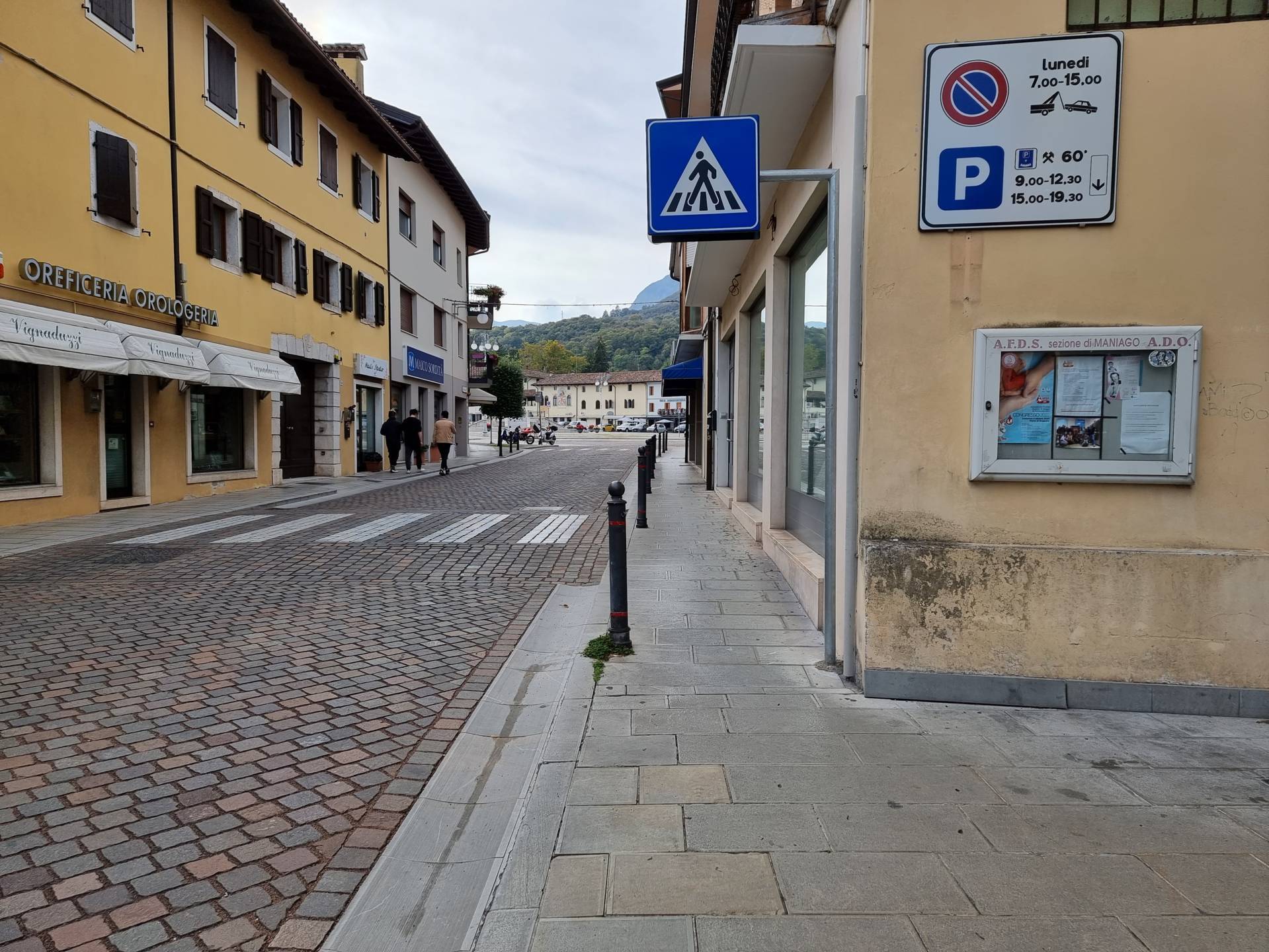
PHOTO 16 - PEDESTRIAN CROSSING
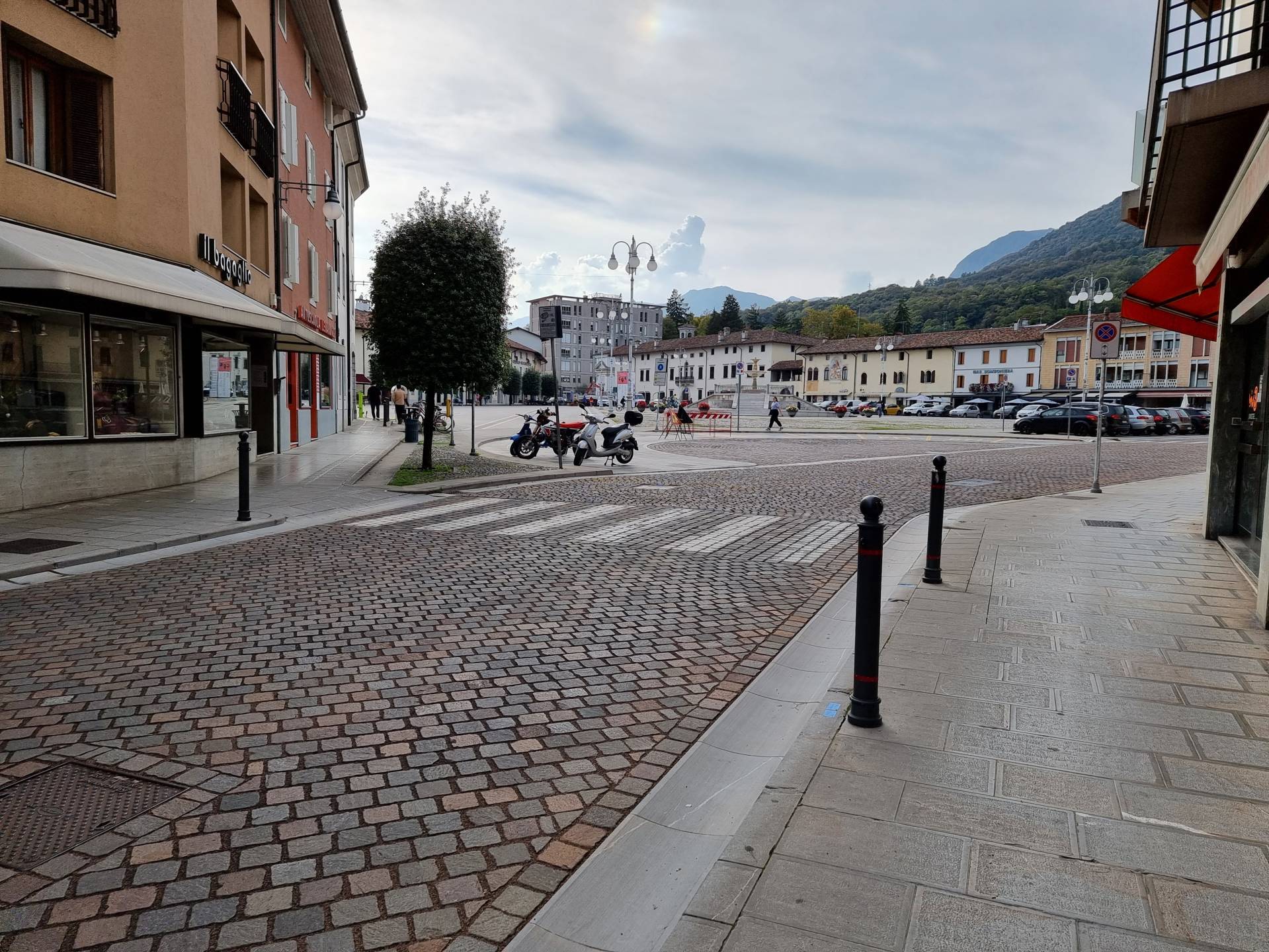
PHOTO 17 - PEDESTRIAN CROSSING AT THE SQUARE
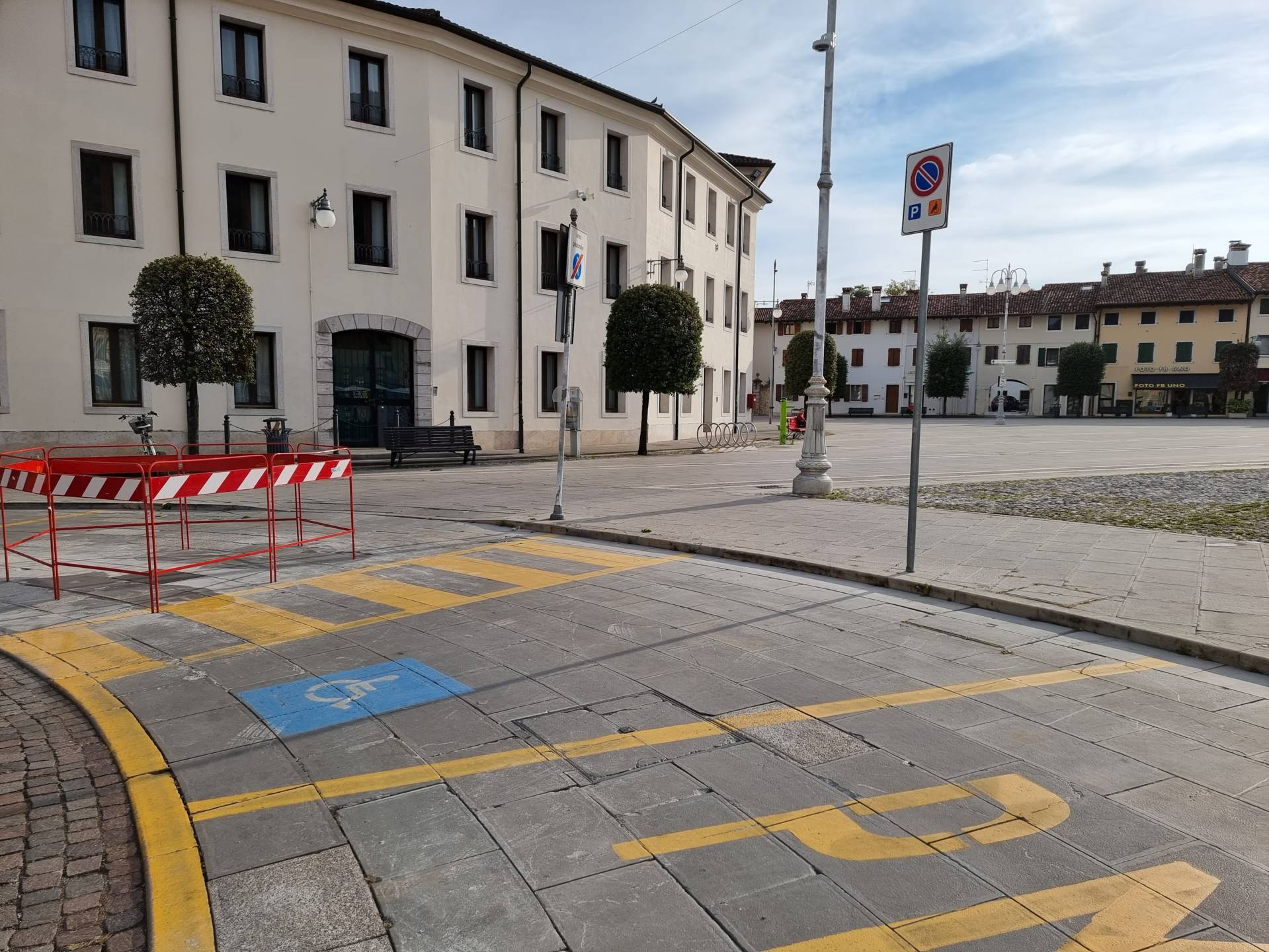
PHOTO 18 - SQUARE
Continue straight along the northern edge of Piazza Italia. Before reaching Via Roma, Piazza Unità has two more pedestrian crossings with the same characteristics as described previously (Photographs 19-20). On the left, at street number 63, there is a car park reserved for people with disability. The crossing on Via Roma (Photographs 21-22) is on the right; it is flat, on a surface made of porphyry cubes, faded white stripes, a somewhat irregular surface, and crosses Via Castello (Photograph 23) (also signposted as the others described previously); the pavement still maintains the same characteristics: a regular and uniform surface made of piasentina stone, and there are connecting ramps. The itinerary continues along the west side of Piazza Italia.
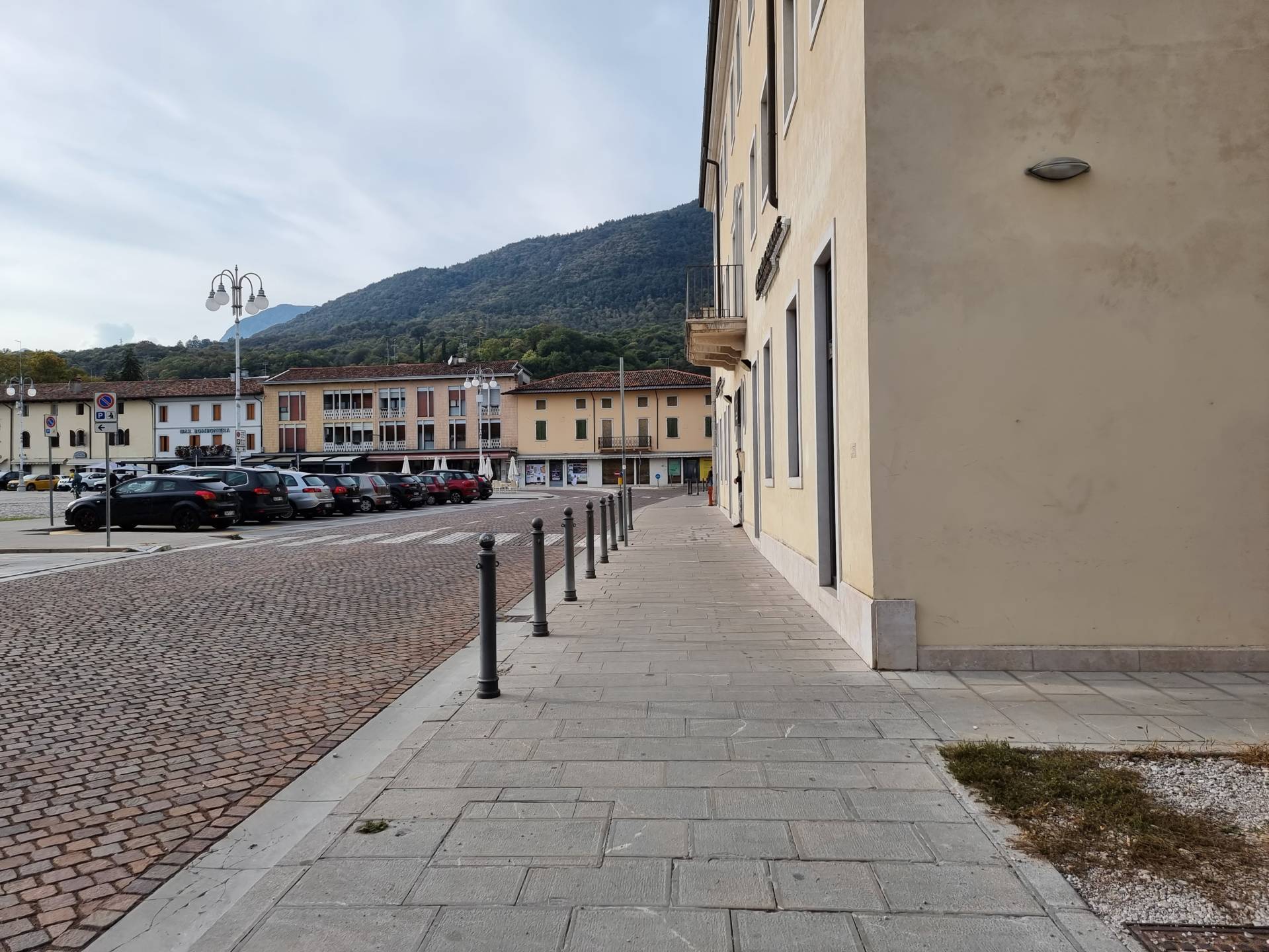
Photo 19 - Pedestrian crossing

PHOTO 20 - PEDESTRIAN CROSSING

PHOTO 21 - VIA ROMA AND VIA CASTELLO
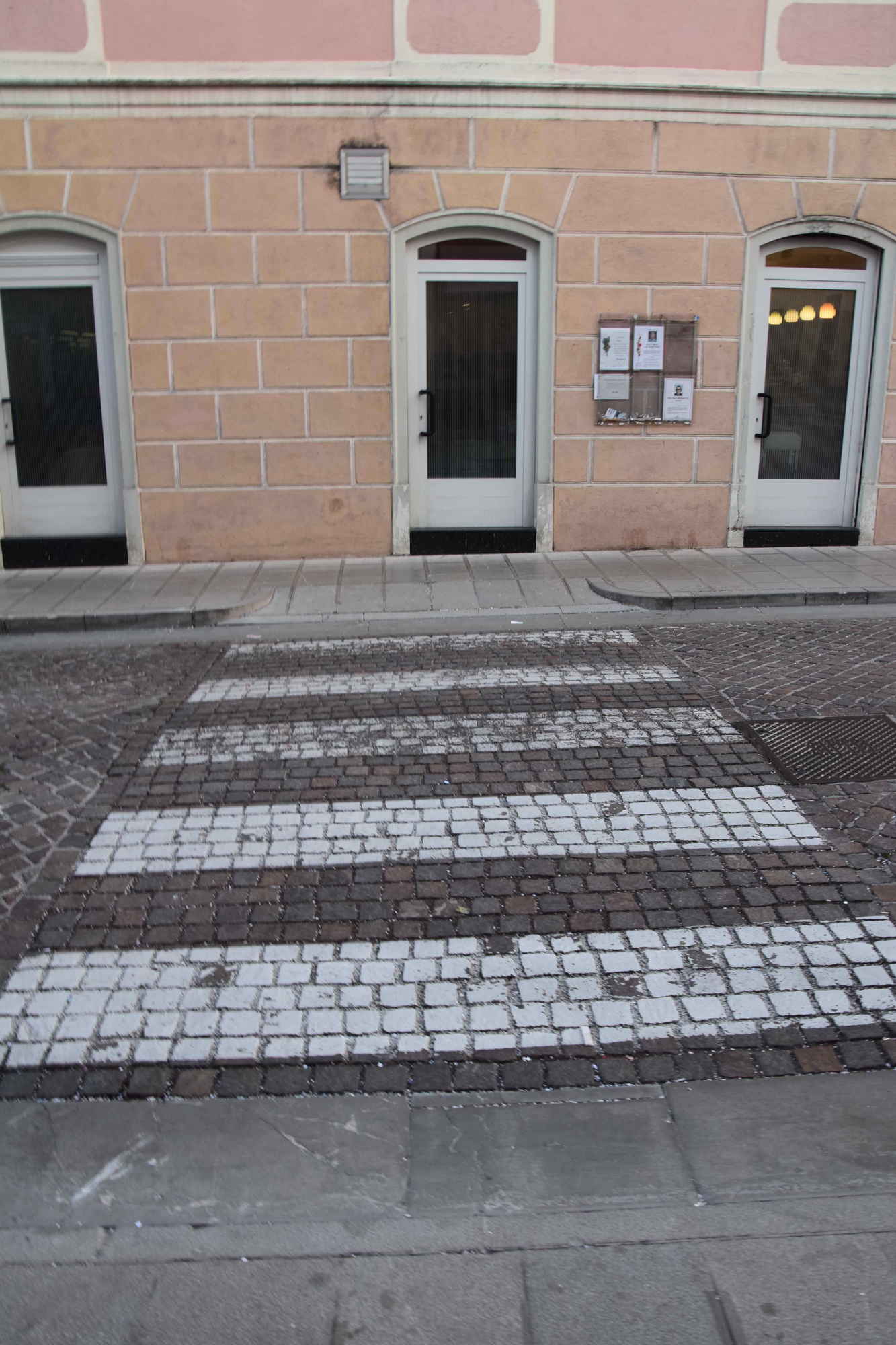
PHOTO 22 - PEDESTRIAN CROSSING ON VIA ROMA
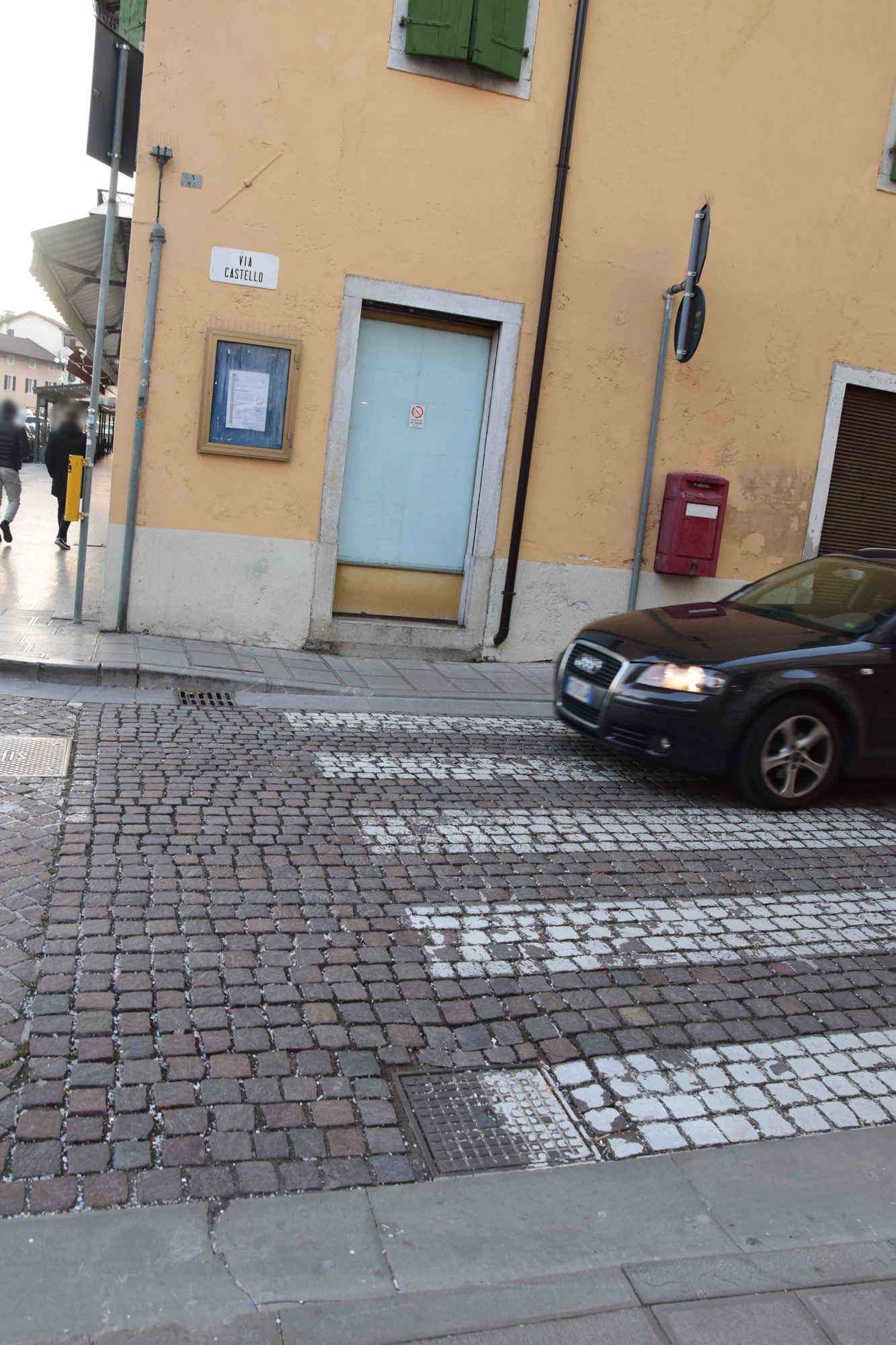
PHOTO 23 - PEDESTRIAN CROSSING ON VIA CASTELLO
he west side of the square features numerous businesses and hospitality venues; the pavement has the same characteristics as described previously. The pavement serving the businesses, therefore, has a difference in height from the level of the square of approximately 10-14 centimetres, which is connected with ramps at the level of the driveway entrances. Two uneven pedestrian crossings (photos 24-25) are located here, with the same characteristics as the previous ones, then continue along the second of these leading to the central part of the square and from here to the pedestrian area surrounding the Duomo. Proceeding towards the pedestrian zone near the Duomo, after having travelled through one of the two previous pedestrian crossings, there are several parking spaces at the edge of the square, arranged in a semi-circular manner, one of which is reserved for people with disability. The pedestrian area towards the Duomo is paved with slabs of piasentina stone, with a flat, uniform surface (Photographs 26-27). On the east side of the square, after the turn to the right towards the pedestrian area, is the Town Hall building (Photograph 28).

PHOTO 24 - PEDESTRIAN CROSSING

PHOTO 25 - PEDESTRIAN CROSSING
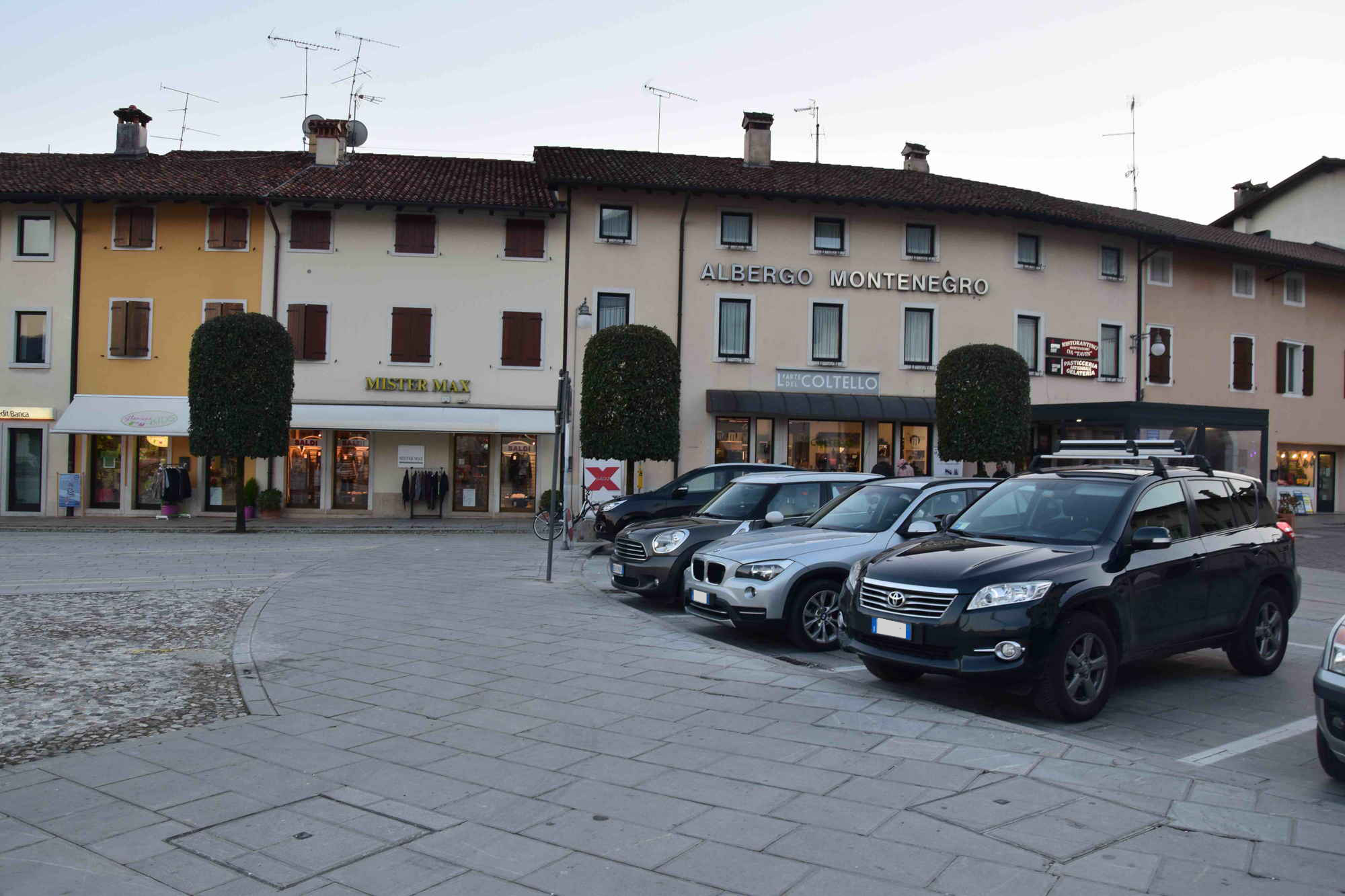
PHOTO 26 - SQUARE
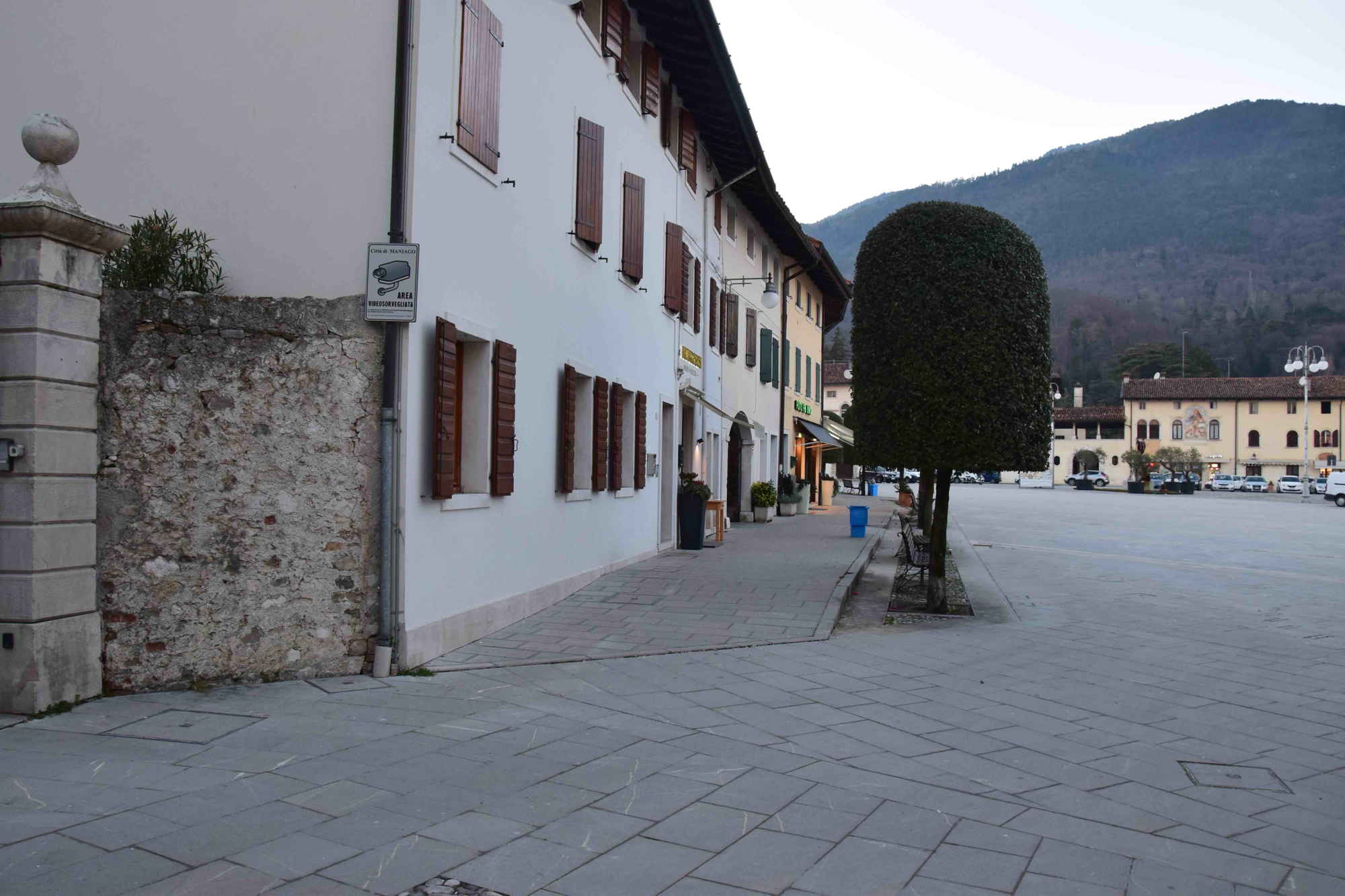
PHOTO 27 - ROUTE TO THE DUOMO

PHOTO 28 - TOWN HALL
The pedestrian area leading to the entrance of the Duomo is paved in piasentina stone slabs like the square, with a regular and uniform surface with a constant width. To the right of the itinerary, there is a gravel area and to the left a strip of piasentina stone (Photographs 29-30). Continuing the itinerary to the right, the paving in piasentina stone is located on the level, followed by porphyry paving with a slightly uphill ramp leading to another porphyry pavement adjacent to the playing fields (Photograph 31). The itineraries all have a regular and uniform surface and are broad in width. Around the Church, the paving is in piasentina stone.
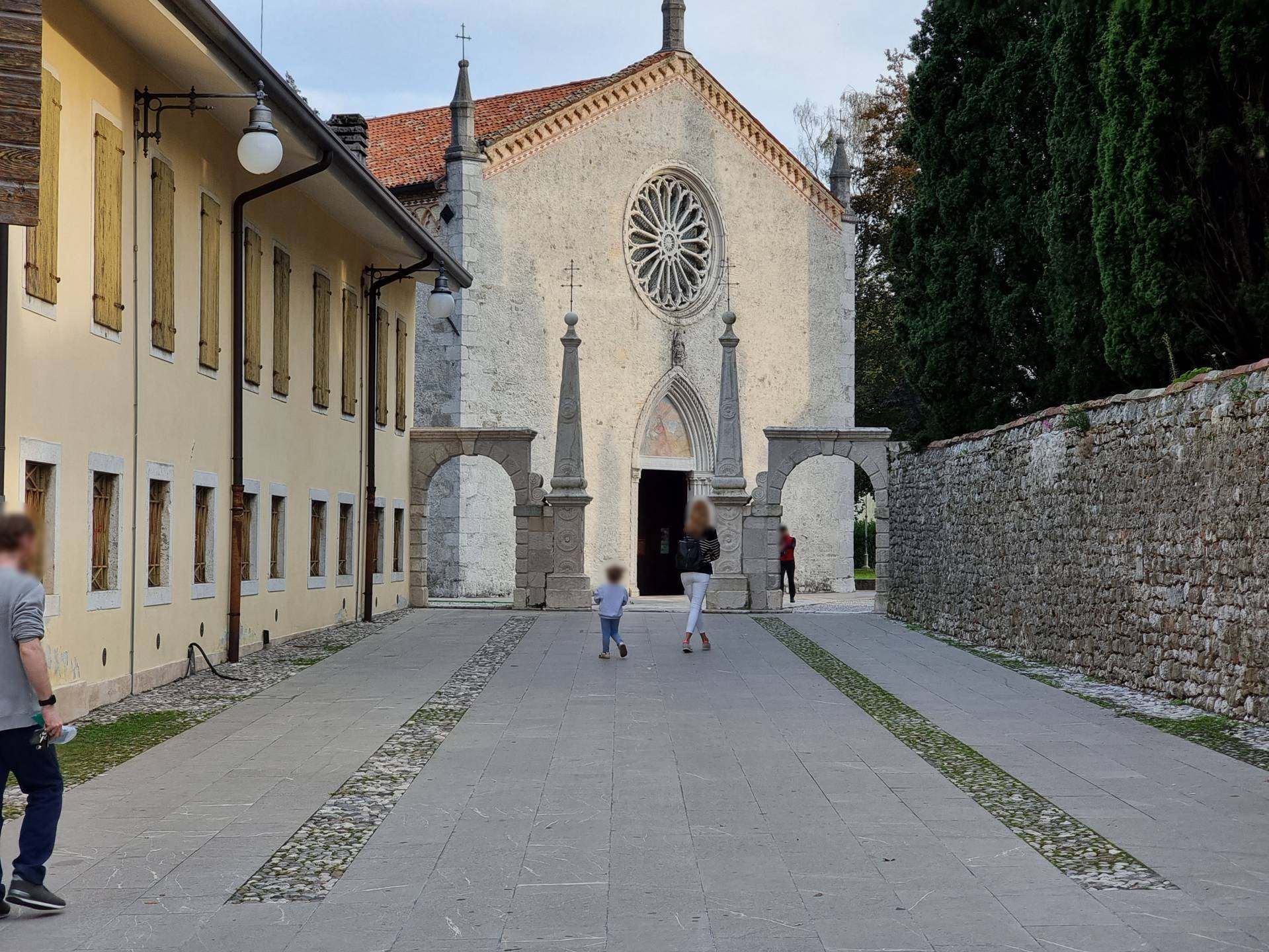
PHOTO 29 - ROUTE TO THE DUOMO

PHOTO 30 - LEFT BAND IN PIASENTINA
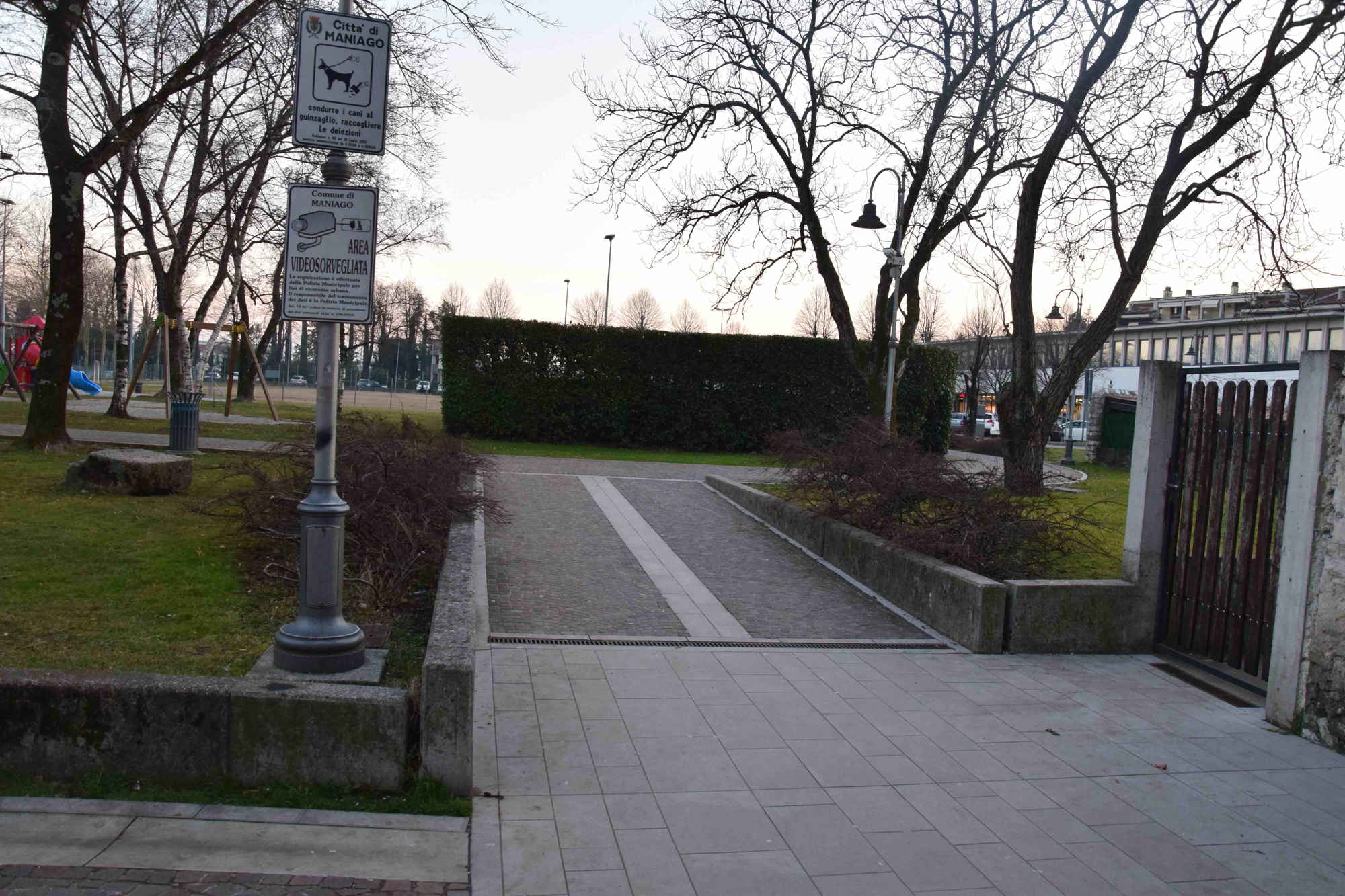
PHOTO 31 - PORPHYRY RAMP
The final part of the itinerary continues with the return to Via Fabio di Maniago and the right turn along Via Regina Elena (Photograph 32). The initial part of the pavement, on both sides, is in piasentina stone, with a broad width and uniform surface, elevated from the road surface and made of porphyry cubes, then the paving of the pavement becomes dark pink washed concrete. There is a broad width and an even, uniform surface. Continuing straight ahead at the car park on the left of Via Regina Elena, there is a pedestrian crossing with white stripes on a paved surface, which is partially joined to the road surface because, on the left side, it presents a difference in height of 7 centimetres (Photograph 33). In this car park, with about sixty parking spaces, there are two parking spaces for people with disability.
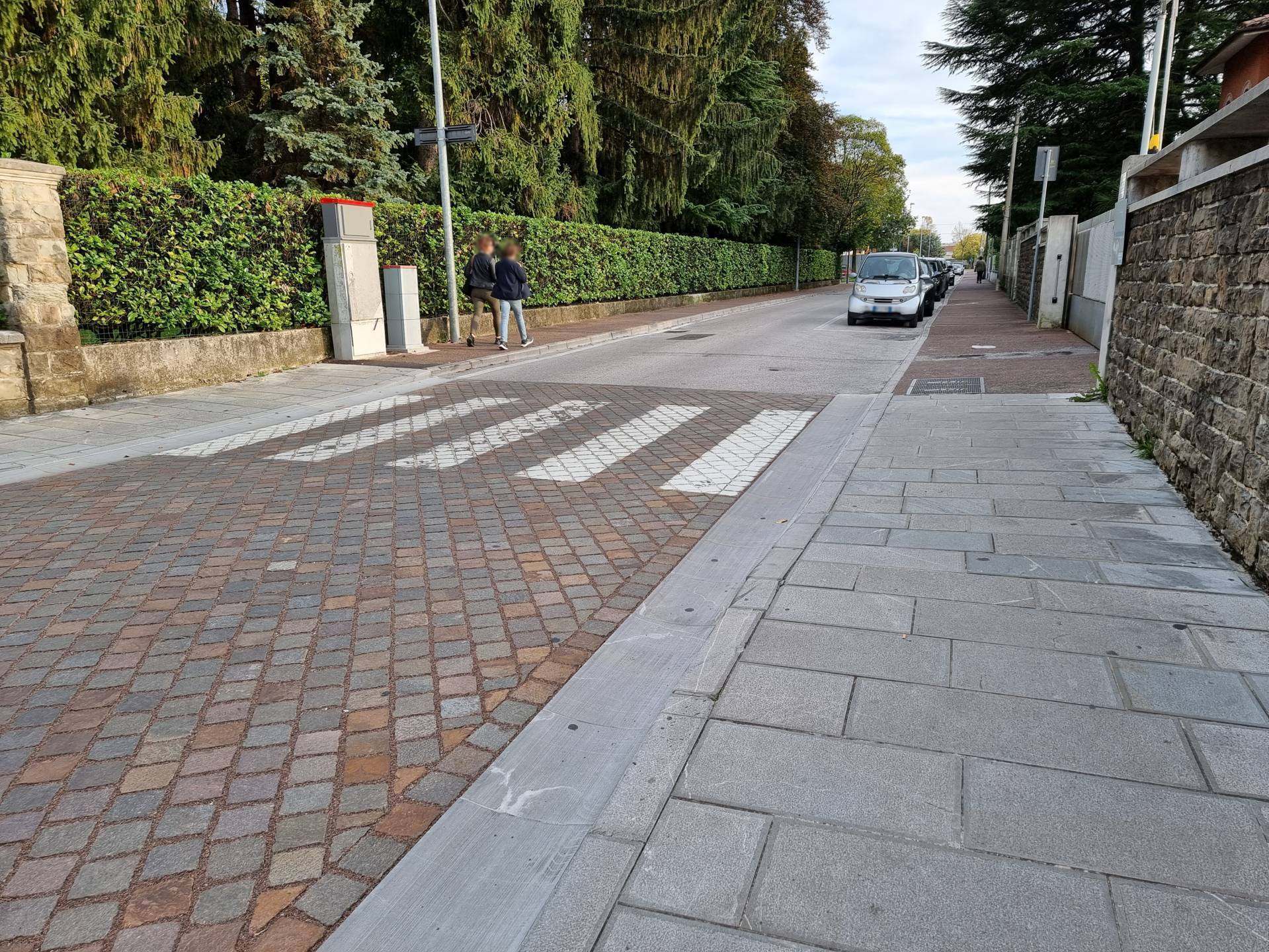
PHOTO 32 - PEDESTRIAN CROSSING ON VIA REGINA ELENA
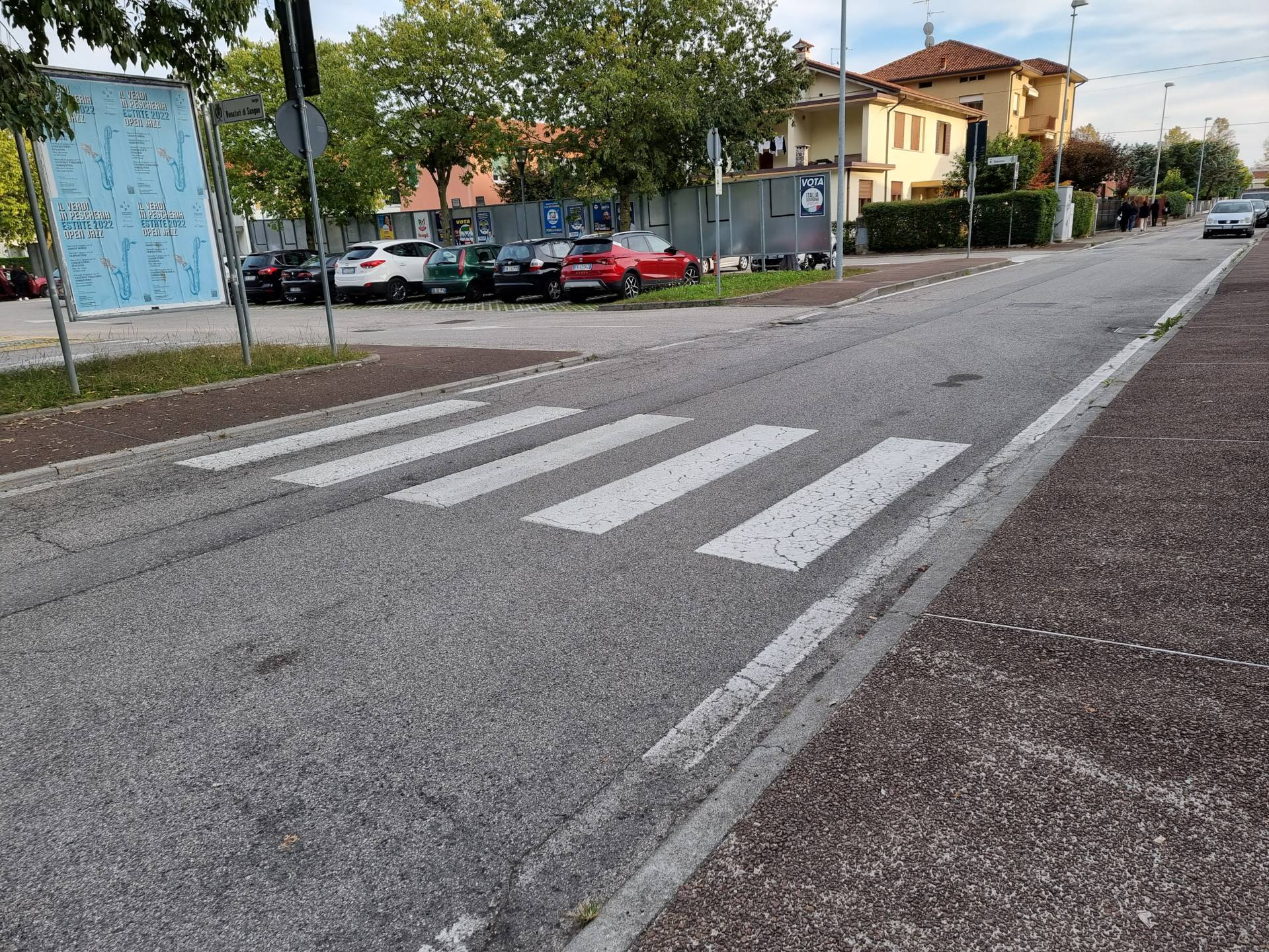
PHOTO 33 - PEDESTRIAN CROSSING NEAR THE CAR PARK
To return to the itinerary's starting point, at the end of the car park, turn left along Via Beato Odorico, which has a pavement on the left side that is approximately 1.00 metre in width, with dark, pink-washed concrete paving and an even surface. At the end of Via Beato Odorico, there is a parking space for people with disability.;.
The last pedestrian crossing on Via Beato Odorico, towards Via Vittorio Emanuele, near the parking area reserved for people with disability, is connected to the pavement on the right side (Photograph 34). The pedestrian crossing is marked with white stripes on a paved surface. From Via Beato Odorico, continue along the pavement to the left, turn left towards Via Vittorio Emanuele and cross the latter at the first pedestrian crossing to reach the pedestrian area in front of the Museum of Smithy Art and Cutlery, the starting point of the itinerary.

PHOTO 34 - STALL AND PEDESTRIAN CROSSING ON VIA BEATO ODORICO
2.9
/3
ENTRANCE

Rampa

Ingresso
Entrance typology
TYPE:
MainACCESSIBLE:
YesTIPO:
PrincipaleHeight difference (> 2.5 cm)
PRESENT:
YesDISLEVEL:
-
TYPE:
RampUNIVOCAL CODE:
RA1RAMP:
WIDTH (CM):
200LENGTH (CM):
140SLOPE:
SLOPE (°):
2.86SLOPE (%):
5CORRIMANO:
PRESENT:
NoSIDE KERB:
NoNON-SLIP FINISH:
NoYES:
COLOUR CONTRAST:
NoYES:
TACTILE-PLANTAR PATHS:
No
Threshold (< 2.5 cm)
PRESENT:
No/LevelEntrance door
TYPE:
With two doors or with two opening elementsOPENING:
InsideAUTOMATED OPENING:
NoNET DOOR CLEARANCE:
With two doors or with two opening elementsOVERALL BORE (CM):
190MAIN DOOR (CM):
95DOOR AND BACK DOOR COPLANARITY (NOT ASSESSED HEIGHT DIFFERENCE UP TO 2.5 CM):
YesZERBINI/CARPETS:
PRESENTS:
NoINTERCOM/BELL:
PRESENT:
YesHEIGHT (CM):
120LOCATION:
Door sideGlass doors: window decals to indicate their presence
PRESENTS:
NoCOMPARTMENT

Bancone
Compartment name
TYPE:
Generic, of the structureIDENTIFIER:
V1Door
ACCESS:
NoneDimensions
ROTATION DIAMETER 140 CM:
YesLARGHEZZA LIBERA PREVALENTE:
> 75 cmPaving
TYPE:
TilesColour contrast floors/walls
TYPE:
YesFLOOR COLOUR:
Beige/GreyWALL COLOUR:
WhiteSignage
YES:
TACTILE-PLANTAR PATHS:
NoYES:
TOUCH MAP:
NoYES:
INFORMATION SIGNAGE:
YesFurniture
COUNTER:
-
HEIGHT:
UniqueGROUND CLEARANCE (CM):
85EMPTY UNDER:
No
General note
CONNECTION PATHWAYWAY

Ascensore
Connection
ITINERARY IDENTIFIER:
C1DA:
Generic, of the structureA:
Generic, of the structureType of route
YES:
InsideInternal itinerary characteristics
DIMENSIONS:
PREVAILING CLEAR WIDTH:
> 75 cmPAVING:
TYPE:
Tiles, MoreOTHER TYPOLOGY:
ResinCOLOUR CONTRAST FLOORS/WALLS:
FLOOR COLOUR:
Beige/GreyWALL COLOUR:
VariousSIGNAGE:
YES:
TACTILE-PLANTAR PATHS:
NoYES:
TOUCH MAP:
NoYES:
INFORMATION SIGNAGE:
YesHEIGHT DIFFERENCE (> 2.5 CM):
PRESENT:
YesDISLEVEL:
-
TYPE:
Elevator/elevator platform with closed compartmentUNIVOCAL CODE:
AS1ELEVATOR/ELEVATOR PLATFORM WITH CLOSED COMPARTMENT:
DOOR TYPE:
a doorNET DOOR CLEARANCE (CM):
90YES:
SPACE IN FRONT OF DOOR 140X140 MIN:
YesCABIN SIZE:
DOOR SIDE (CM):
135BLIND SIDE (CM):
150EXTERNAL BUTTON PANEL:
AVERAGE HEIGHT (CM):
115BRAILLE:
YesRELIEF :
YesCOLOUR CONTRAST:
NoINTERNAL BUTTON PANEL:
AVERAGE HEIGHT (CM):
130BRAILLE:
YesRELIEF :
YesCOLOUR CONTRAST:
NoBUZZER:
NoEMERGENCY CAMERA:
No