 MAP
MAP
FVG: A Region for All
The genesis of "A Region for All"
Since 2015, PromoTurismoFVG has been working in synergy with the Regional Council of Persons with Disabilities and their Families of Friuli Venezia Giulia within the project A Region for Everyone, which was established following the signing of a memorandum of understanding that is renewed over time.
We have embarked on this journey with a clear goal: to contribute to the development of truly accessible and inclusive tourism in Friuli Venezia Giulia, putting the person and their needs at the center. For us, accessibility means going beyond the elimination of architectural barriers, also addressing sensory, informational, and cultural barriers, and promoting a structural and lasting change in the way of thinking about and designing tourism.
To turn this vision into concrete actions, over the years we have developed, and continue to carry out, a complex set of activities in the area: inspections and mappings, training and awareness-raising courses aimed at tourism operators, and above all the collection and sharing of objective, detailed, and constantly updated information on accessibility.
Our goal is to allow every visitor to independently assess whether facilities, services, and routes meet their needs, to experience Friuli Venezia Giulia as a true guest, regardless of their requirements.
The heart of the project: mapping and detecting accessibility
The accessibility mapping is coordinated by the CRIBA FVG – Regional Center for Information on Architectural Barriers and Accessibility, with the support of qualified external collaborators. Together we manage both the survey activities in the territory and the entry of data into the portal FVG for Everyone.
How we assess accessibility
We document routes and facilities through:
- descriptions precise text,
- photographs,
- detection sheets differentiated by type of structure, built according to the specific characteristics of the spaces.
The cards collect objective data, designed to meet the various needs of visitors. Among the elements recorded, we consider, for example:
- the presence and type of elevation changes,
- the width of the doors,
- the color contrast and the tactile-plantar signage,
- the acoustic characteristics of the environments,
the presence of trained staff for the reception of people with disabilities.
All assessments are carried out directly on site by trained and qualified personnel, mainly architects. A fundamental principle for us is the reliability of the information: we never include data based on self-declarations from the managers of the facilities.
The detection phase takes place using software specifically developed for the project, which we have gradually refined over time thanks to the experience gained during the inspections.
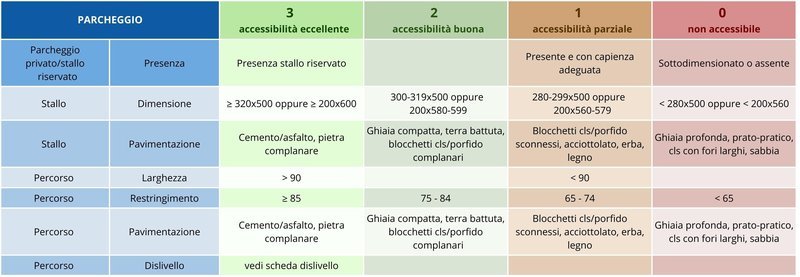
To facilitate the consultation of information by end users, each structure has been assigned a synthetic accessibility indicator with a value ranging from 0 to 3, to which is associated the icon of a face with different colors and expressions.
This indicator is calculated based on similar indicators assigned to each of the spaces that make up the structure and that take into account the fields considered most significant - primarily for physical accessibility and the absence of architectural barriers. The value 3 represents the highest level of accessibility.
We are currently working to make the accessibility summary indicator more comprehensive and useful for people with different accessibility needs, not just motor ones.