 MAP
MAP
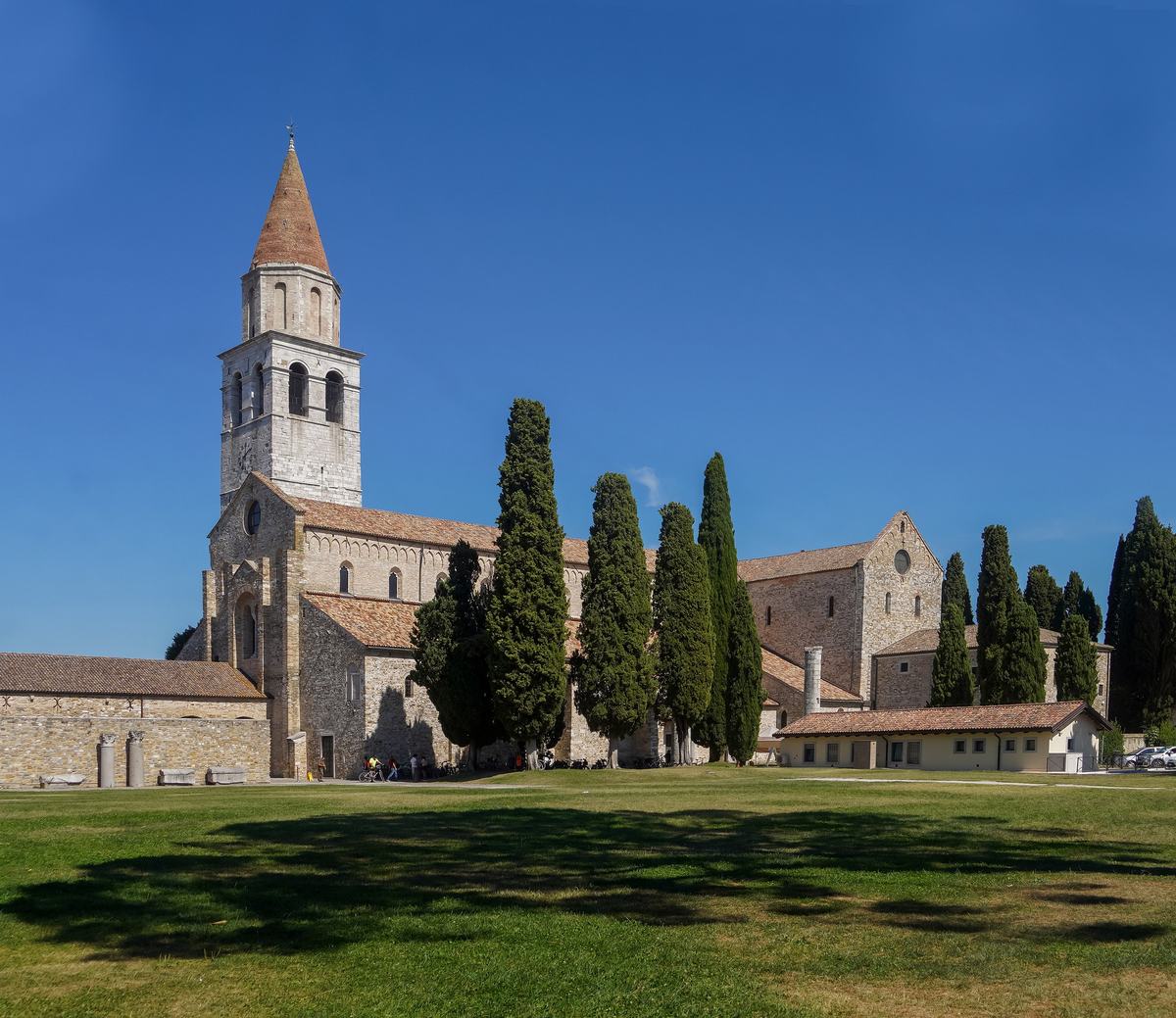
Among early Christian mosaics, Roman remains, and quiet streets to stroll through without haste, Aquileia is a must-see stop for anyone wishing to visit Friuli Venezia Giulia.
A few kilometers from Grado and the lagoon, in the low Friulian plain, Aquileia was one of the great cities of the Roman Empire and is today one of the most important cultural sites in Friuli Venezia Giulia. The Patriarchal Basilica and the archaeological area are recognized as UNESCO World Heritage, but the value of the destination lies not only in its history.
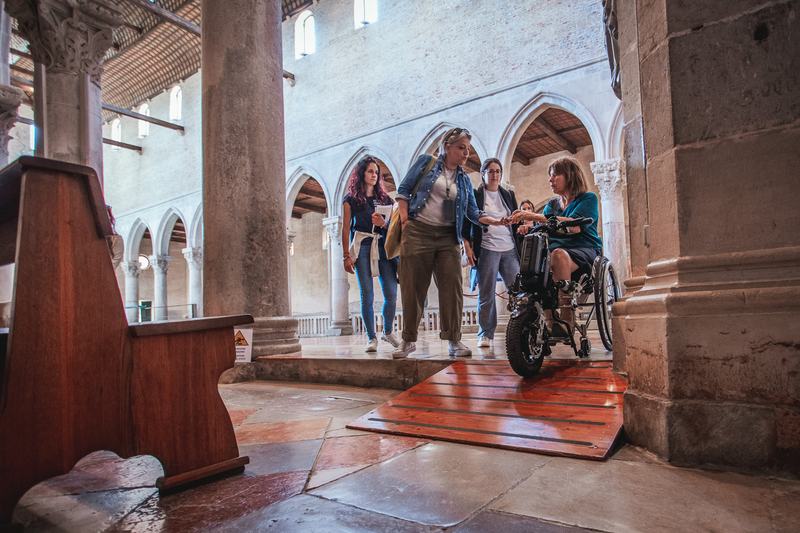
Aquileia is also a place that in recent years has continuously worked on accessibility: compact spaces, points of interest close to each other, clearer visiting tools, and paths designed to welcome people with different needs. At the center of this journey is the Patriarchal Basilica, famous for its extraordinary early Christian mosaic floor and the protagonist of the project Basilica for All.
The project, promoted by the Foundation for the Conservation of the Basilica of Aquileia, was created with the aim of making this place of worship, art, and memory more accessible and usable. It should be emphasized that this is a project strongly desired by everyone, starting with the director of the Basilica, Dr. Andrea Bellavite, and the CEI (Italian Episcopal Conference), represented by Sister Veronica Donatello, head of the pastoral office for people with disabilities, as well as the support - also financial - of the Friuli Venezia Giulia Region.
As Anna Maria Viganò, the project coordinator, recounts, “Basilica for All” was born almost four years ago with the aim of making the Basilica “a place accessible to all people.” For the Foundation, accessibility is not an additional element, but part of the very nature of the place: “The Basilica is a place of worship, faith, history, and art. For this reason, it cannot be inaccessible to some people.”
A project built over time
Basilica for all has developed progressively, addressing different dimensions of accessibility.
The first focus was on people with visual disabilities, then on people with hearing disabilities, and subsequently on people with motor disabilities, with interventions on pathways and access points. The work then expanded with materials dedicated to people with intellectual disabilities, including a guide in Easy to Read and a publication in CAA (Augmentative and Alternative Communication).
It is therefore not a single intervention, but a path that has grown over time, through listening, planning, training, and the support of specialised professionals and skills.
Solomon's Knot: discovering a mosaic through touch
One of the most representative elements of the project is the Solomon's Knot, a tactile mosaic panel that reproduces one of the mosaics of the Basilica.
Anna Maria Viganò defines it as “the pride and joy” of Basilica for all: a reproduction made with ancient Roman mosaic techniques, designed to be explored through touch while discovering the construction technique of a mosaic. A video content in LIS (Italian Sign Language) version tells its story for deaf visitors.
The value of the project, however, lies not only in the tools created but in the method. “Everything you see in the Basilica — the Solomon's knot, but also the 3D reproduction in wood — was made not simply by following what we thought was right or beautiful, but what was useful and at the same time beautiful for the person with a specific disability,” explains Viganò.
Accessible tools are not only useful to a specific audience. Easy to Read and AAC guides, for example, can help people with intellectual disabilities, but also children, school groups, families, and visitors who prefer simpler and more immediate content.
When supports meet hospitality
Ornella Tortul, head of personnel, recounts an episode that summarizes well the essence of the project.
During a school visit, a boy with a disability who initially did not want to enter the Basilica was able to participate thanks to the accessible guides given to his support teacher. “The boy entered with these guides and came out very happy,” he recounts. The colleague who had suggested the materials then said: “Today I brought home the day!”
For Tortul, this is the difference with the project Basilica for All: “We are always here. It's not about having not just one type of support, there is not just one digital tool. We are here with the heart.”
It is an important passage because it describes accessibility not as a sum of support materials, apps, or devices, but as a way of relating to people. Tools are useful, but they really work when accompanied by trained staff, attention, and a willingness to listen.
From the accessibility of the visit to inclusive labour
Today the project also opens up to a new theme: the right to work.
After some therapeutic internship experiences carried out in collaboration with ASUGI, the Foundation is starting a training internship aimed at job placement. The person involved will be engaged in welcoming activities, support to the shop, and, depending on their skills, also in some administrative tasks.
“If all goes well, if she feels comfortable with our staff and the work activity, we think we can integrate her permanently,” explains Tortul.
The goal is to build a more lasting life and work project, in a place that puts hospitality, culture, and participation at the center.
In this case as well, the path involves the entire community of the Basilica. The future intern introduced herself before the project started by telling her colleagues: “I will be your future colleague.” The staff welcomed her immediately, naturally. A small but significant episode: accessibility also grows through a shared internal culture.
A heritage to enjoy together
Basilica for all shows how a cultural site can become a laboratory of accessibility: not only through tools and materials, but also through training, listening, relationships, and work inclusion.
Making the Basilica of Aquileia accessible means allowing more people to encounter beauty, understand it, and feel part of a shared heritage.
Do you want to check all the information about the physical accessibility of the Basilica before your visit?
Discover the card with the mapping dedicated to the Basilica
Discover all the Basilica for All activities on the Museum for All portal

